




Chang Jin, chief scientist of the Dark Matter Particle Explorer (DAMPE), introduces the satellite at the Purple Mountain Observatory under the Chinese Academy of Sciences (CAS) in Nanjing, east China's Jiangsu Province, Nov. 2, 2017. (Xinhua/Ji Chunpeng)
"Each of China's science satellites is of high quality, and I believe China could gradually become a major player in the field of space science," said Wu Ji, chairman of the Chinese Society of Space Research.
XIAMEN, Oct. 29 (Xinhua) -- China plans to launch four new science satellite missions by 2023, and scientists have completed concept research on another five to be launched in the next 10 years.
Successful Chinese science satellites launched since 2015 include the Dark Matter Particle Explorer (DAMPE), the Quantum Experiments at Space Scale (QUESS) and the Hard X-ray Modulation Telescope (HXMT). These were under a space science program of the Chinese Academy of Sciences (CAS).
The second phase of the program has now started, Wang Chi, director of the National Space Science Center under the CAS, recently told the first China Space Science Assembly in Xiamen, east China's Fujian Province.
The first mission of the second phase was Taiji-1, China's first satellite to conduct in-orbit experiments on key technologies related to space-based gravitational wave detection, which went into space on Aug. 31, 2019.
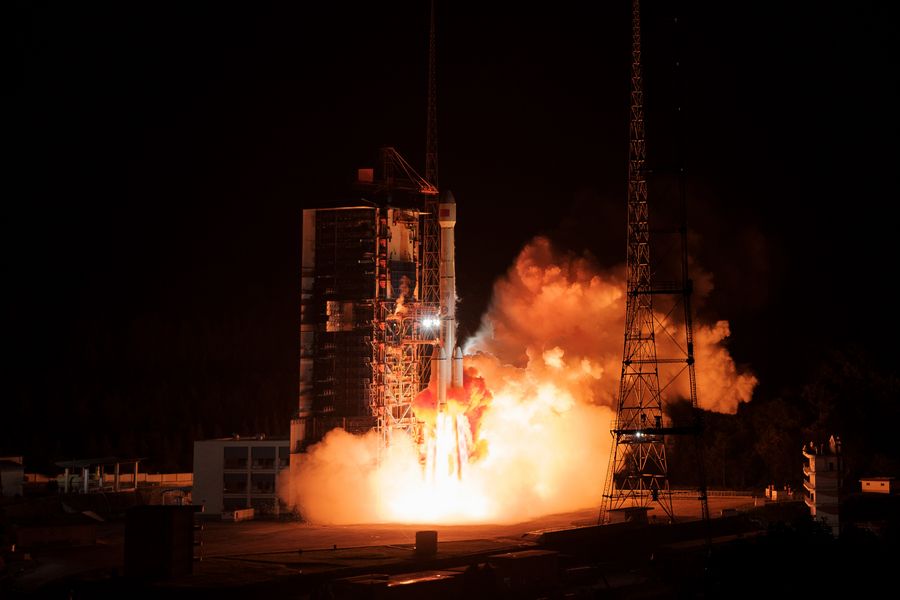
A new communication technology experiment satellite is launched by a Long March-3B carrier rocket at the Xichang Satellite Launch Center in Xichang, southwest China's Sichuan Province, Oct. 17, 2019. (Photo by Guo Wenbin/Xinhua)
The four new missions include the Gravitational Wave Electromagnetic Counterpart All-sky Monitor (GECAM), expected to be launched at the end of 2020, which will search for electromagnetic signals associated with gravitational waves, Wang said.
The Advanced Space-borne Solar Observatory (ASO-S), expected to be launched at the end of 2021, will help scientists understand the solar magnetic fields, flares and coronal mass ejections.
A satellite named Einstein-Probe (EP), tasked with discovering celestial bodies that emit X-rays during fierce changes as well as quiescent black holes with transient high-energy radiation, is expected to be launched at the end of 2022.
The Solar Wind Magnetosphere Ionosphere Link Explorer, or SMILE, is a Sino-European joint mission expected to be launched at the end of 2023. It will focus on the interaction between the solar wind and the earth's magnetosphere.
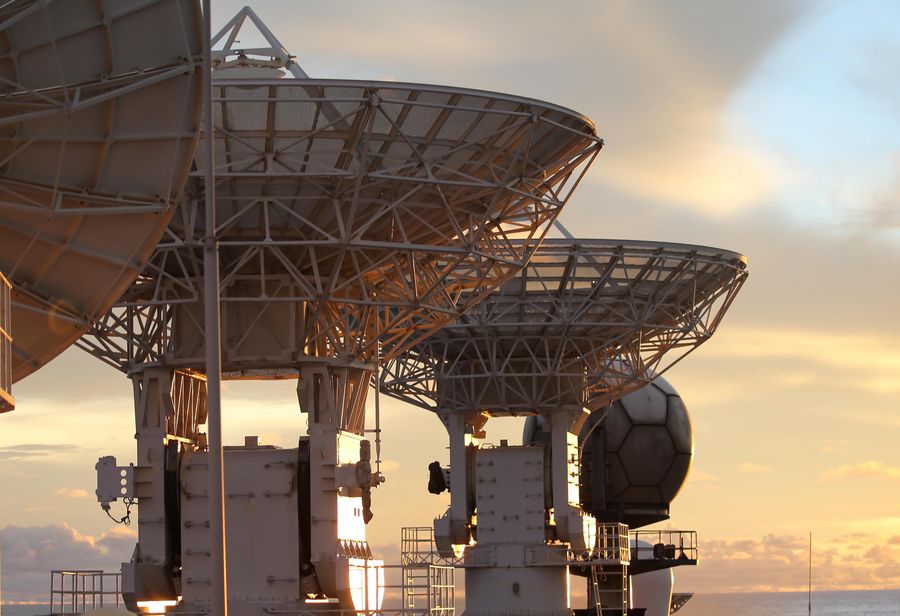
The radar facilities on China's spacecraft tracking ship Yuanwang-3, east China's Jiangsu Province, June 18, 2019. (Xinhua/Liu Shiping)
Chinese scientists have also completed concept research on five satellite missions that will focus on the study of physics in extreme conditions in space, space-based gravitational wave detection, medium and high-orbit quantum technology experiments, ultra-long-wave astronomical observation and asteroid and comet exploration, said Wang.
The satellites successfully launched in recent years have ushered in a new era for China's space science development, said Wu Ji, chairman of the Chinese Society of Space Research.
However, China is still a newcomer in the field of space science. Compared with the several hundred science satellites of the United States, dozens from the European Space Agency and almost 20 from Japan, the number from China is still small, said Wu.
"Each of China's science satellites is of high quality, and I believe China could gradually become a major player in the field of space science," Wu said. ■
