





Aerial photo taken on June 29, 2019 shows the Sanguantang building complex which once served as the Red Army's command center during the 1934 Battle of Xiangjiang in Jieshou Town of Xing'an County, south China's Guangxi Zhuang Autonomous Region. (Xinhua/Lu Boan)
NANNING, July 7 (Xinhua) -- At 8 o'clock every morning, 72-year-old Huang Ronggao would arrive at an exhibition hall that exhibits a battle during the Long March, welcoming visitors from across the country.
The three-story exhibition hall, just a two-minute walk from his home in Guanyang County of south China's Guangxi Zhuang Autonomous Region, was built in 2016, with a pentagram-shaped main building and a sculpture that depicts battle scenes in front of it.
In two months, a new and larger hall will be completed in another area in the county. Most of the exhibits will be transferred there by that time.
Huang felt a bit upset about the relocation since the veteran witnessed the exhibition hall rise straight from the ground and its opening to the public.
This week, platoons of tourists, including railway bureau staff, police officers and college students, came to visit the hall as a way to celebrate the 98th anniversary of the founding of the Communist Party of China.
Visitors lined up for a tour and packed the medium-sized hall to the door to see old photos of the high-ranking commanders of the Workers' and Peasants' Red Army of China and items used by the soldiers, including straw sandals, counting frames, pistols, grenades and kettles.
Huang joined the military in 1964 as a frontier army man and became a village cadre since retirement. He, now the Party chief of Paibujiang Village in Guanyang, is called the "old curator" of the exhibition hall, which commemorates the fierce battle of Xinxu there between the Red Army and the Kuomintang (KMT) party forces.
In mid-October 1934, the Red Army soldiers launched the most epic military maneuver in China's modern history -- the Long March. They had broken three KMT blockade lines in less than one month and a half since they left their base in eastern China.
The Battle of Xinxu was one of the three major block battles fought in Guangxi, which had bought time for the Red Army to cross the Xiangjiang River.
The Red Army suffered heavy losses in the Battle of the Xiangjiang River, with its soldier number being reduced by nearly half in the five-day battle.
Memorial halls and martyrs' cemeteries are springing up in many revolutionary places over the past few years, especially those along the Long March route.
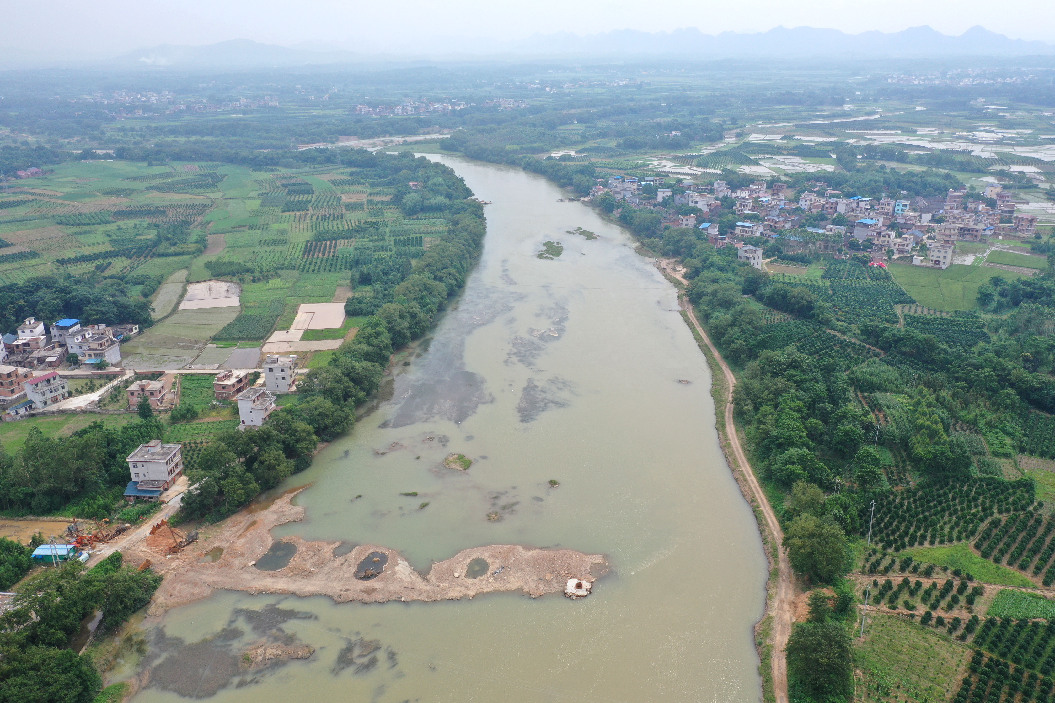
Aerial photo taken on June 29, 2019 shows a bridge under construction near a historical site of the 1934 Battle of Xiangjiang in Quanzhou County, south China's Guangxi Zhuang Autonomous Region. (Xinhua/Zhou Hua)
Visitors from all over China come to these memorials, reconnecting with history, reclaiming the Long March spirit and adding more momentum to the red tourism boom.
In Yudu County, Jiangxi Province, where the Long March started, an obelisk by the river marks the beginning of this great journey.
In Rucheng County, Hunan Province, where the Red Army had a short respite, an exhibition hall witnessed the inseparable relationship between the army and the people.
Last year, nearly 300,000 visitors came to see the "halved quilt" offered by three female Red Army soldiers as a gift for a local peasant woman there 85 years ago.
In Xing'an of Guangxi, where the Battle of Xiangjiang River took place, a memorial hall recreated the tragic sacrifices and eventual victory of the Red Army in the winter of 1934. A new hall and martyrs' cemetery will soon be built.
In Zunyi, Guizhou Province, where the crucial turning point of the Long March occurred, the memorial hall of the Zunyi Meeting receives around 5 million tourists every year.
These are only part of the many red education bases in China that tell the story of the Long March, which had changed the course of China's revolution and the fate of the country.
Huang's village is taking on a new look since China's red tourism has been in full swing in recent years. The old man has lived there all his life, and is proud to do something for his village.
Speaking of the forthcoming relocation, he said that he would accept the arrangement for both the exhibition hall and his unknown position-to-be.
His phone rang. He dived into his pocket and fished out a cellular phone for the elderly, with a loud voice prompt of the number of the incoming caller.
The phone call was from his son. The old man would spend the weekend with his 13-year-old grandson.
"I will take him to the exhibition hall and tell him the Long March stories," he said.
