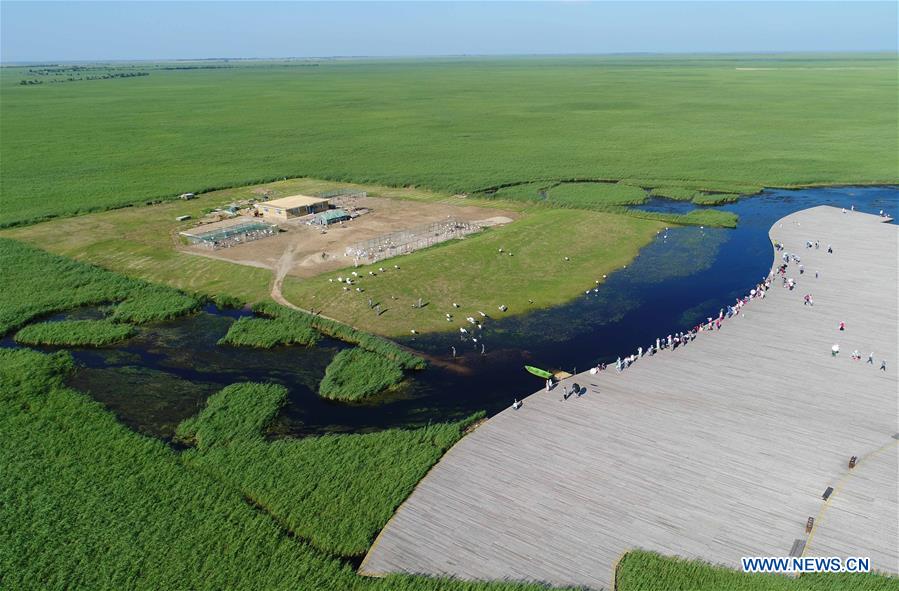
Aerial photo taken on July 31, 2018 shows the scenery of Zhalong National Nature Reserve in Qiqihar, northeast China's Heilongjiang Province. When summer comes, the Fujin National Wetland Park in northeast China's Heilongjiang Province becomes a paradise for wild birds. However, it was a completely different scene years ago. The wetland park used to be a huge tract of low-lying farmland. The original ecological system of the wetland has been restored since policies were implemented to turn marginal farmland into forests, grassland and wetlands across the province. Heilongjiang boasts bountiful wetland resources, with 55,600 square km of wetlands. Zhalong National Nature Reserve, some 700 km away from the Fujin wetland, has also seen an increasing number of rare birds in recent years. The province has unveiled wetland protection regulations as early as 2003, one of the earliest provinces in China to carry out local legislation to protect wetlands. In 2018, the province stepped up efforts to manage illegal agricultural development and tourist facilities around wetlands in Heilongjiang. Meanwhile, tough measures to crack down on illegal hunting of wildlife and more campaigns of wildlife protection have been carried out in the province over the past few years. (Xinhua/Wang Kai)
HARBIN, June 27 (Xinhua) -- When summer comes, the Fujin National Wetland Park in northeast China's Heilongjiang Province becomes a paradise for wild birds. However, it was a completely different scene years ago.
The wetland park used to be a huge tract of low-lying farmland. The original ecological system of the wetland has been restored since policies were implemented to turn marginal farmland into forests, grassland and wetlands across the province.
Heilongjiang boasts bountiful wetland resources, with 55,600 square km of wetlands.
Zhalong National Nature Reserve, some 700 km away from the Fujin wetland, has also seen an increasing number of rare birds in recent years.
Located in western Heilongjiang, the Zhalong nature reserve covers a total of 210,000 hectares. It is the main breeding ground for red-crowned cranes and white-naped cranes in China, as well as a stopover for many other migratory birds.
"Illegal fishing and bird hunting have disappeared. Villagers' environmental awareness has been improved," said Lyu Gang, a resident of Dangnai Village, located on the edge of the reserve.
The 64-year-old said villagers would help or report bird injuries to relevant departments when they found injured birds. In the past, some villagers made their living from fishing and a few caught and ate birds.
Thanks to the wetland protection efforts, the ecosystem has been significantly improved, said Lyu, who has seen flocks of rare birds flying to the wetland every summer.
The province has unveiled wetland protection regulations as early as 2003, one of the earliest provinces in China to carry out local legislation to protect wetlands.
To restore the ecosystem of Zhalong nature reserve, residents who used to live in the nature reserve started to move out in 2017.
Guan Tiecheng's family was relocated from the core area of the nature reserve to a new village in November 2017.
"The relocation policy is supported by villagers, as it not only protects the environment but also increases villagers' incomes," said Guan, adding he and some villagers now live in modern apartments provided by the local government, and they can continue to do farm work or find new jobs, and are allowed to fish at certain times.
In 2018, the province stepped up efforts to manage illegal agricultural development and tourist facilities around wetlands in Heilongjiang.
The province introduced an ecological compensation mechanism aiming to protect the environment and promote the harmony between human and nature last year, turning 34.6 square km of farmland into wetlands and adding three more national wetland parks.
Heilongjiang has also been upgrading its geographical information system and monitoring platform of nature reserves, to strengthen wetland monitoring and management, according to the provincial forestry and grassland department.
Meanwhile, tough measures to crack down on illegal hunting of wildlife and more campaigns of wildlife protection have been carried out in the province over the past few years.
"Pragmatic measures have brought significant changes to wetland ecology, with water quality improving, wetland areas expanding, and an influx of migratory birds," said Xu Aiguo, an official of the local environment department.?