



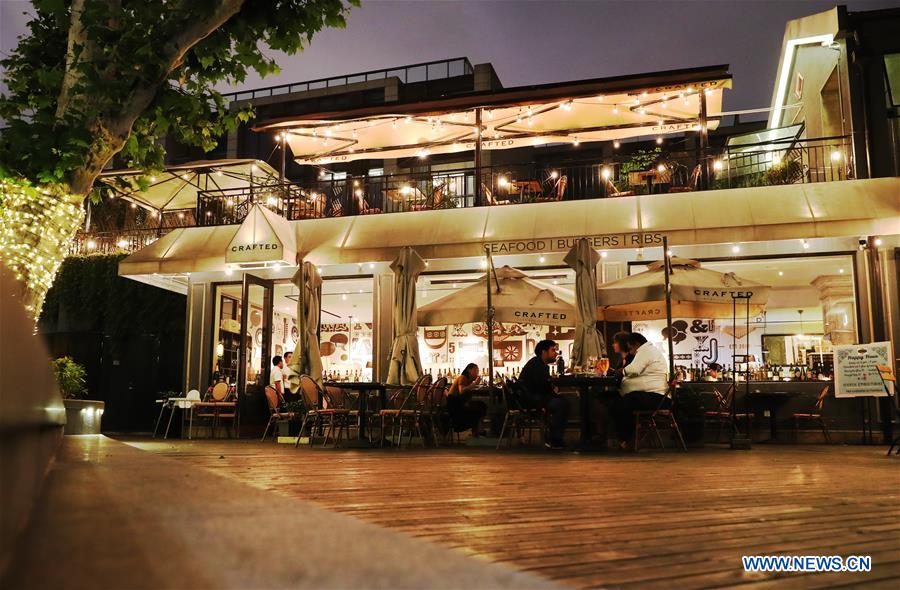
Customers enjoy dinner at a restaurant in the Yong Ping Lane of Xuhui District, east China's Shanghai, May 27, 2019. (Xinhua/Fang Zhe)
SHANGHAI, May 29 (Xinhua) -- On the 97-year-old Hengshan Road in downtown Shanghai, there is a small gate that can be easily missed. When people walk through it at night, they will be fascinated by a complex of elegant buildings bathed in soft yellow lighting.
With more than a dozen restaurants, cafes and boutiques, the 9,600-square-meter complex, called Yong Ping Lane, is a rather new nightlife destination frequented by both Chinese and foreigners.
This is a glimpse of the booming nightlife in Shanghai and many other "sleepless" cities in China. Many have introduced measures this year to boost the nighttime economy -- business activities between 6 p.m. and 6 a.m. in the service sector.
YONG PING LANE
Apart from Chinese hotpot and American burgers, people can find some of the rarest exotic cuisines at the Yong Ping Lane, including Turkish, Peruvian and Czech food.
"When I opened my restaurant here eight years ago, many people thought I would fail," said Emre Gurel, a Turkish national who came to Shanghai to work for a multinational company 12 years ago. "Now we have a group of regular customers -- half Chinese and half foreigners. They like the food, environment and music here."
Emre is the owner of a Turkish restaurant named "Garlic", which opens exclusively at night from 6:00 p.m. to 11:30 p.m.
A rejuvenation project two years ago made his restaurant part of today's beautiful and vibrant quarter.
"Behind my restaurant, there used to be an area for waste metals and machines," said Emre. "After the project, Yong Ping Lane was created and it suddenly became so beautiful."
When developing Yong Ping Lane, Cornes Property ruled out bringing in restaurants that could produce "heavy fumes and smoke," said Rose Leung, general manager of the Shanghai Cornes Property Co., Ltd.
"We chose lighter foods, such as Western restaurants and cafes," Leung said. "We don't allow music outdoors. And when designing exhaust systems and where outdoor seats are put, we also tried to minimize disruptions to nearby residents."
NIGHTLIFE CEOS
In April, the Shanghai municipal government introduced a guideline on promoting the nighttime economy. Measures include the appointment of experienced nightlife business managers as "nightlife CEOs" -- assistants and advisors to officials, in light of the successful experience in megacities around the world.
So far, more than ten people, mostly managers at real estate or retail companies, have been appointed to this job. Clarence Lee, manager of a property development project at Xintiandi, is among them.
Lee said Xintiandi, a landmark area of shopping, eating and entertainment in Shanghai, will provide even richer nightlife by hosting more cultural and social activities.
The nighttime economy will help Shanghai, as an international metropolis, further boost tourist spending and improve the business environment, said Liu Min, deputy director of the Shanghai Municipal Commission of Commerce.
According to Shanghai's plan, the city will draw up the development plan of the Nightlife Agglomeration Area and add more parking spaces, taxi waiting areas and late night bus services.
While introducing more diverse programs like operas, musicals and museum tours, Shanghai will take a more open view of late night bookstores, cinemas, music clubs and live houses.
Every city should have its own signature feature for nightlife, said Wei Yi, vice president of the America China Public Affairs Institute. "Nighttime consumption is a boost for the economy and provides many job opportunities. The key is to balance the needs of the community with the business sector," said the New York resident who frequently visits Shanghai.
Nightlife is vital to Shanghai's economy as well as its identity, said Chen Wen, principal of leading consulting company Oliver Wyman. The nightlife has long been an important incubator of cultural movements and will continue to provide spaces for creativity and social cohesion, he said.
"SLEEPLESS" CITIES
Nighttime economy is booming in many Chinese cities, particularly in the major ones where a large number of young people work overtime or stay up late.
According to a report issued by Meituan Dianping, a popular online O2O platform, China's nighttime dining consumption went up by 47 percent in 2018, higher than the daytime growth, with Beijing and Shanghai ranking the top two in nighttime dinning consumption. The report also shows that most of the consumers are in their twenties and thirties.
Many cities across China have also rolled out plans to stimulate the nighttime economy to drive growth amid downward pressure on the broader economy.
Chongqing, for example, is working to create more nightlife attractions, including recruiting street artists from around the world to a major nightlife center.
Beijing announced last month its plan to build and upgrade 10 food streets into "midnight canteens" for night owls in the next three years. According to its government work report earlier this year, Beijing will encourage malls, supermarkets and convenience stores to stay open later.
DIVERSIFYING NIGHTLIFE
The nightlife boom came after increasingly rich Chinese citizens increased their spending on leisure.
Zou Tongqian, deputy director of the expert committee of the World Tourism Cities Federation, said the nighttime economy can help extend business hours, boost employment and consumption and become a new bright spot for economic growth.
The nighttime economy in Chinese cities, now primarily related to dining and shopping, should further optimize the supply structure as the urbanites are upgrading their spending from merchandise to services, said Zhao Ping, a researcher with the Academy of China Council for the Promotion of International Trade.
Chen Lifen, an official with the Ministry of Commerce, said cities should speed up the nurturing of booming service sectors, including film, entertainment, tourism, health care and sports, for more nightlife scenes.
"Nighttime economy has become an important part of the urban economy," said Dai Bin, president of the China Tourism Academy. "It can meet the material and cultural consumption upgrading of urban residents and also is a major channel for tourists to have a taste of local culture and life," said Dai.
(Video reporter: Zhang Mengjie, You Zhixin, Zhou Rui, Wu Baoshu; Video editor: Zhu Cong)
