




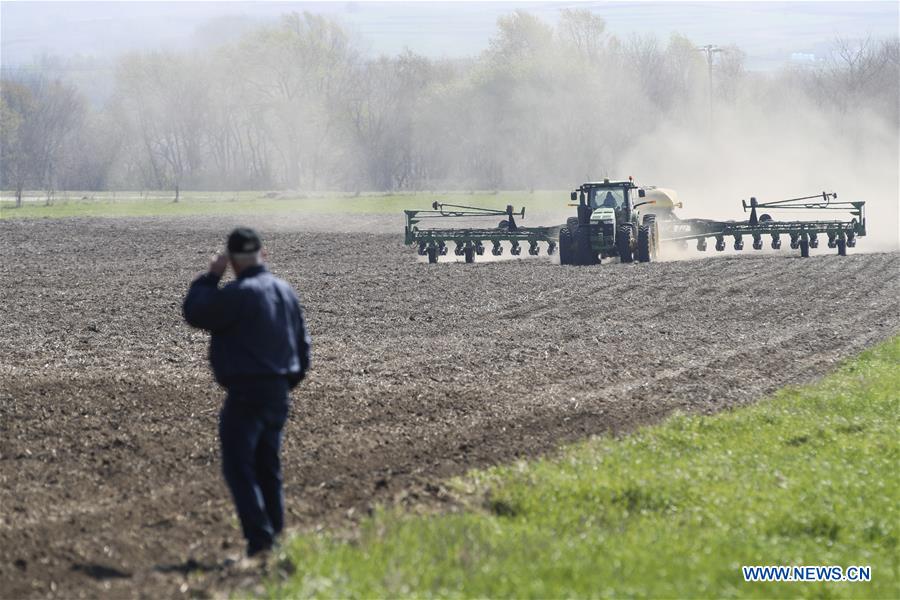
Bill Pellett watches as his son Bret plants corn with a planter machine at their family farm in Atlantic of Cass county, Iowa, the United States, April 24, 2019. Bill Pellett knows how to farm, but just like most of his peers across the country, the 71-year-old farmer is feeling less assured of what he could get from a new year of farming, as there appears to be no quick resolution of the year-long trade disputes between the United States and China. (Xinhua/Wang Ying)
DES MOINES, the United States, May 23 (Xinhua) -- Bill Pellett knows how to farm, but just like most of his peers across the country, the 71-year-old farmer is feeling less assured of what he could get from a new year of farming, as there appears to be no quick resolution of the year-long trade disputes between the United States and China.
A fifth-generation farmer, Pellett has been producing corn, soybeans and beef at his 6,000-acre family farm for most of his life in Atlantic, a small city in the U.S. state of Iowa, which is often dubbed "America's granary."
"We definitely suffered some loss from the trade problems," said Pellett while working on one of his corn fields in late April, the beginning of a new crop season.
Last summer, the United States imposed additional tariffs on billions of dollars of Chinese imports. China immediately retaliated, with tariffs that hit American agricultural products the most.
According to Pellett, the prices of soybeans have fallen by 10 to 15 percent mainly due to reduced exports to China, a major market for American soybeans before bilateral trade relations stalled.
Pellett's family produces 768,000 bushels of corn and 190,000 bushels of soybeans annually. But a bumper harvest could mean further losses under current circumstances.
"There's a lot of excess production of soybeans right now. The surplus seems to be growing on the soybeans instead of diminishing," said the seasoned farmer.
Pellett also raises nearly 2,000 head of cattle. In January 2018, he took a business trip to China for the first time to promote his beef there, as American beef just returned to the Chinese market after a 14-year ban due to the mad cow disease outbreak.
During the week-long trip, Pellett was stunned by the Great Wall, as well as a ride on the high-speed rail. Everything he saw made him more determined to bring more of his products to the Chinese market. But the onset of the trade war made his ambitions hard to realize, at least for now.
"The trade friction between the two countries has been building for a long time and it needs to be solved," said Pellett.
For Grant Kimberley, marketing director of the Iowa Soybean Association, the sharp contrast in export statistics before and after the trade conflicts is really alarming and frustrating.
Prior to the trade stand-off, "about one third of all the soybeans grown in the United States were destined for China," while Iowa is the country's second biggest soybean producing state, said Kimberley, who himself is a sixth-generation soybean farmer with a family farm near Des Moines, the state capital.
Kimberley told Xinhua that U.S. soybean exports to China saw a sharp decline over the past year, and about half of the supplies that would normally have gone to China now went to somewhere else, with farmers still at a deficit for net total exports.
The further escalation of trade tensions earlier this month, with Washington raising additional tariffs on 200 billion U.S. dollars of Chinese goods from 10 percent to 25 percent, dampened Kimberley's hope for some quick, positive changes.
"With prices going lower and soybean supplies growing -- and with only modest hope that a resolution is near -- we're likely to be mired in this scenario for some time," he added. "For some farmers, the crop they're currently planting may be their last."
According to Mike Naig, Iowa's secretary of Agriculture, the agriculture sector is "a significant economic driver" for the state, which helps create one in five local jobs and contributes some 25 percent of the local GDP.
As exports are "really a big part of what makes Iowa agriculture work," the disruptions and uncertainty triggered by the trade disputes would hurt farmers and their products' market, Naig told Xinhua during a recent interview.
China has "rising standards of living and an increasing middle class that is bigger than the entire U.S. population," which provides great business opportunities for American and Iowan farmers who "strive to be a consistent quality supplier," the secretary elaborated.
Apart from soybeans and meat, some value-added products of corn, such as dried distillers' grains as livestock feed, and ethanol as clean fuel, have also become new hot sells from the state to China, he noted.
Calling the trade relationship between the United States and China a "valuable one," the secretary stressed, "We don't want to damage relationships that we've all established over these many years."
"You have to work together to get to know each other and establish business relationships and supply chains, and to disrupt that -- that's very difficult and unfortunate," he added.
Speaking of the current situation, the secretary said, "we are anxious to see this all resolved and get to a place where we can start doing business again -- not just like we were, but even better."
He was echoed by Pellett the farmer, who repeatedly told Xinhua that he still "has faith" in the two nations' agreement to a final deal that is good for both.
But if things continue to turn for the worse, "I will cut cost, reduce production, and tighten the belt," said Pellett.
