NANNING, Feb. 21 (Xinhua) -- In a tea garden in the village of Shanping, Wuzhou in south China's Guangxi Zhuang Autonomous Region, Zhu Xuelan of ethnic Yao group is busy teaching locals how to sift the best tea leaves.
The remote village, administered by Liubao Township and once troubled by grinding poverty, is well-known for its distinctive Liubao Tea, a type of dark tea characterized by its strong and refreshing aroma as well as medical effects.
In recent years, with the help of Zhu, who is the secretary of the Shanping Village branch of the Communist Party of China (CPC), locals in the village managed to get rid of poverty by cashing in on the tea industry.
"Even though we have shaken off poverty, it's necessary to consolidate our efforts by strengthening the tea industry here, so locals will not return to their once impoverished lives," Zhu said.
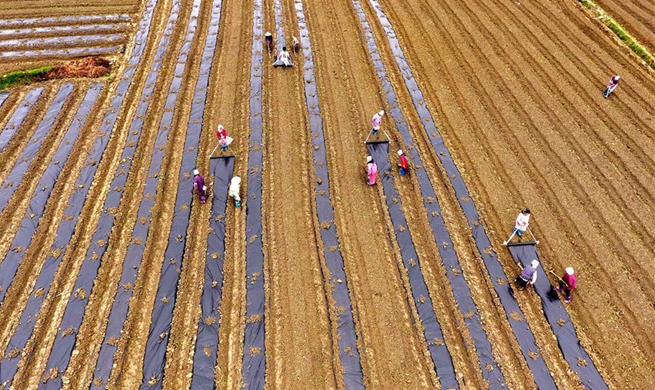
Agriculture, rural areas and farmers' issues have remained China's top priorities. For 16 years in a row, the central authorities released the "No. 1 central document" prioritizing development of agriculture and rural areas.
This year's "No. 1 central document" was made public Tuesday by the CPC Central Committee and the State Council.
Existent policies will be fully implemented to ensure the country's poverty elimination targets are attained -- to lift all its rural residents living below the current poverty line out of poverty by 2020.
China is making fast progress towards eliminating poverty, with the number of impoverished rural residents declining from nearly 100 million in late 2012 to 16.6 million by the end of 2018.
"I hope to bring our village to the next level so people here can continue to live good lives through the tea industry," Zhu said.
PROSPERITY GROWS ON TEA TREES
Liubao Tea, which prospered during the Tang Dynasty (618-907), requires very delicate techniques to grow and process, and the recipe to success was usually kept a secret among some families in the township. Zhu's family grew and produced top quality Liubao Tea for generations.
But the overall tea quality in Shanping Village was not so satisfactory. The village has an average altitude of at least 700 meters and is a key production base of Liubao Tea, but only families like the Zhus could grow tea trees that produce great-quality tea leaves.
"The traditional tea industry in the village was dwindling due to poor growing techniques among different families, and people were struggling to make ends meet," Zhu said.
In 2008, Zhu was appointed secretary of the village CPC branch and began to mull ideas about rekindling the time-honored tea business.
"My grandfather and my father were very famous tea-making masters, and they passed on the techniques to me," Zhu said. "I thought about telling the villagers about the secret ways of growing tea trees and making good Liubao tea."
Liubao Tea making involves a very complicated process, including softening tea leaves, kneading, moistening, heaping, drying and maturing. When Zhu proposed telling the recipe to locals, she was met with strong opposition from family members, especially her son.
"The recipe is a family honor, and you cannot share it with others unconditionally," he said. But Zhu argued that if she did not do so, the villagers would forever be stuck in the impoverished mountains.
"As the Party secretary here, I have the responsibility," she said.
Zhu stuck to her guns and shared her tea-growing techniques generously. She transformed her tea-making house into a classroom, carefully imparting everything she knew about tea-making to tea farmers.
"When there were many people, I would ask my father and my son to teach them one by one," she said.
The students called her "Master Zhu," and she managed to teach 1,000 villagers tea-making techniques and train more than 20 farmers into tea-making masters like herself.
"She not only taught me how to grow tea trees but also helped me sell them," said local tea farmer Huang Xueqing, 63. "My tea garden has expanded to more than 3 mu (0.2 hectares), and I can earn up to 3,000 yuan (about 444 U.S. dollars) a year. I am truly grateful for Secretary Zhu."
The Liubao Tea industry in Shanping started to re-emerge, and the hand-made tea's prices started to climb. In 2013, the tea cost just about 75 yuan per kg, but now the tea sells for up to 300 yuan per kg.
The tea business also expanded to the city of Wuzhou. Last year, more than 18,000 people were engaged in the tea business in Wuzhou, and the area of Liubao Tea trees exceeded 5,333 hectares in the city.
TEA-BASED TOURISM
Due to the remote landscape of the village, Zhu figured that locals could easily fall back into poverty if they relied solely on the tea industry, so she worked on cultivating a related industry in Shanping: tourism.
As Shanping is the only ethnic village in the township, Zhu decided to bolster the tourism economy by promoting the traditions of her ethnic Yao group: singing, dancing, drum-beating and clothes of the ethnic Yao people.
In late 2016, Zhu vacated her farmland to help build a public service center for tourists. The following year, she obtained 10 million yuan in public funds to establish a tea-house to entertain visitors. Roads were also built to help ease transportation woes. By the end of 2017, the "ethnic Yao People Culture Team" was launched as part of a tourism development scheme. An ethnic Yao culture festival was also held, drawing big crowds of tourists.
Thanks to Zhu's endeavor, Shanping Village, where 108 households with 505 residents live, bade farewell to poverty in 2016, with per capita income topping 3,000 yuan. In 2017, Liubao was named the "national distinctive town".
Currently, Zhu is thinking about bringing Liubao Tea onto the global stage.
"Liubao Tea was famous worldwide more than 1,500 years ago thanks to the 'Maritime Silk Road,'" Zhu said. "Now it's the time to once again revive the glory of our tea."