by Xinhua writers Chen Yushan, Tian Yun and Li Baojie
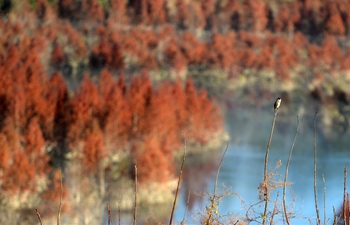
NANCHANG, Jan. 11 (Xinhua) -- George Archibald, co-founder of the International Crane Foundation (ICF), is pleased to see the joint efforts made by local government, NGOs and individuals to look after Siberian cranes in the Poyang Lake, China's largest freshwater lake.
"When I first came here in 1985, we could only find about 1,400 cranes. Now there are more than 4,000," said Archibald, who visited the Poyang Lake in east China's Jiangxi Province for the second time on a four-day trip this week.
"Despite it being raining and windy, we had the most wonderful experience standing on the hillside and looking out and see 1,700 Siberian cranes and swans all in the same basin very near to us," Archibald told Xinhua.
Every year, hundreds of thousands of migratory birds arrive in the the Poyang Lake, which has a surface area up to more than 3,200 square km, for the winter.
Earlier this month, Jiangxi's forestry bureau issued a policy to compensate farmers who lost crops or other harvests to foraging migratory birds.
In 2017, Zhou Haiyan, a photography enthusiast, together with many bird-lovers, launched the "Retaining the Siberian Crane" initiative to build the country's first privately-funded Siberian crane protection zone that combines the functions of scientific research, education and photography.
The joint efforts have paid off. As the crane population increases, people are also seeing more of them in Japan and South Korea, Archibald said.
ICF, which has a regional office in China, is a non-profit organization founded in 1973 to promote conservation efforts for cranes and their ecosystems, watersheds and flyways. Archibald was the organization's director from 1973 to 2000.
"We now have programs in 42 different countries. There are 15 species of cranes, and 11 of them are endangered, so we have a lot of work because there are so many conflicts all over the world as climate change continues to happen. In addition, as the human population continues to increase, there's less space for wildlife," he said.
According to the ICF, there were three migration routes for Siberian cranes. The central and western routes all started at the breeding grounds in Siberia and ended in India and Iran, respectively. The cranes in the Poyang Lake area belong to the eastern route.
For decades, cranes in the central and western routes have been almost extinct due to warfare and hunting.
"When we started the crane foundation, we had one flock of Siberian cranes coming to Iran, but only 12 birds. They were wintering inside an area where local people were trapping ducks and geese, and no guns were allowed. But the population never increased because if they flew outside that area, there was a lot of hunting," said Archibald.
He told Xinhua that in the 1990s, the population of this flock started to decrease. Cranes stopped during their migration to rest on wetlands in Azerbaijan, a neighbor of Iran to the northwest. However, the country was suffering food shortages, and the local government allowed hunting in the spring when many birds came.
The other flock which wintered in India used to be about 200 birds. Firearms were then available in Afghanistan due to war, so the birds were never able to reach India. "We put satellite radios on the cranes in their breeding grounds in Russia, and all their signals stopped in Afghanistan. So we were pretty sure that the population was shot," said Archibald.
"When there's a war, conservation can do nothing really. If you ask what the Poyang Lake means to the cranes, I think it's their life, it's their home."
"Russians and my colleagues in India and Iran dream to re-establish those populations after peace comes. We have the technology to bring them back; all we need is peace and security," he said.