by Xinhua writers: Yu Fei, Hu Zhe, Tan Yuanbin
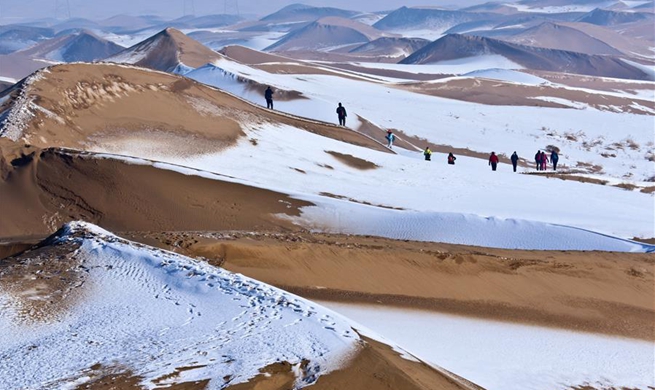
WUHAN, Dec. 10 (Xinhua) -- Herdsmen in Dalad Banner of the Inner Mongolia Autonomous Region, north China, have long suffered from sandstorms. A gust of wind could force people to close their eyes. Sand buried large areas of pasture.
During the worst desertification in the 1980s, more than 100 families had to leave their homes in Jiefangtan Town at the edge of the desert in Dalad Banner.
More than a decade ago, scientists came and started spraying a green liquid on the desert step by step every summer. Gradually, the landscape changed. First came a crust-like cover. This grew thicker, and then the sand stopped moving.
The sand gradually turned into soil, attracting moss, lichens, grass and animals. The soil became thicker, and the vegetation returned.
The hero of this transformation was algae, one of the earliest plant forms to emerge on earth more than 3 billion years ago.
Algae can withstand temperatures up to 60 degrees centigrade, and ultraviolet radiation and drought, said Liu Yongding, a researcher at the Wuhan-based Institute of Hydrobiology of the Chinese Academy of Sciences, who has studied algae for over 40 years.
SAVING LAND
The ability of algae to live in the desert inspired Liu to fix the drifting sand.
Under natural conditions, it would take more than 10 years for desert algae to form a crust.
Liu led his team to select the best algae species from samples collected across China, and innovated technologies that could generate a crust in one year.
Almost 400 million Chinese are affected by desertification, which accounts for 27.3 percent of China's total land area. More than 7.72 million hectares of arable land have been degraded by desertification, and 670,000 hectares of farmland and 235 hectares of grassland have become drift sand or desert.
"We started this research more than 20 years ago without any financial support, but we persisted because we see the potential and the need of the country," said Liu, 74.
"We can't turn all deserts into oases, as deserts play a role in keeping the earth's heat balanced. We aim to control desertification and restore the soil," he said.
SAND RETREAT
Liu's team has collected desert algae samples from Hulunbuir, in Inner Mongolia, to the Taklimakan Desert, in Xinjiang Uygur Autonomous Region. They also compared samples from different times over the past six decades. From a small sample of mature algae crust, they found more than 700 types of organism.
Their desertification control technology has been widely applied in the Inner Mongolia Autonomous Region.
In areas where it was applied, the area of shifting sand fell from 60 percent to 10 percent, and the fixed sandy area rose to 90 percent. The plant coverage area rose from less than 15 percent to more than 80 percent.
"It takes 100 years to form a centimeter of fertile soil and 2,000 years to form 20 cm. It would take many generations to recover if a piece of arable land was lost. We are happy that we found a way to turn sand into soil several centimeters thick that can grow plants in a few years," Liu said.
Liu believes his technology can be used in desert areas outside China, including countries participating the Belt and Road initiative. His research has attracted scientists from Europe and the United States.
EARTH TO SPACE
Liu has also set his sights on the sky.
Since 1987, his team has studied algae to support astronauts' long stay in space.
They have carried out experiments on six of China's returnable satellites, and biological experiments on the Shenzhou spacecraft. They have worked with German scientists to research the life support system on the Shenzhou-8 spacecraft. They will also carry out experiments on China's future space station.
The research can be traced back to the 1970s. "We did an experiment to find out how much algae can keep a person alive in a closed submarine environment," Liu said.
Wang Gaohong, another researcher at the Institute of Hydrobiology, said algae have significant advantages in building a life support system. The oxygen generated by higher plants of about 15 square meters is equivalent to that produced by just a square meter of algae. It can also provide protein for astronauts.
"On the other hand, in near space, at an altitude of about 20 to 100 km, the environment is similar to that of Mars. Our space biology research will also help us understand possible life forms on Mars," Wang said.
TRANSFORMING MARS
Liu has an ambitious goal: letting algae pioneer human migration to Mars.
He first publicly proposed using algae to transform the environment of Mars about 15 years ago. "The deserts on earth have a similar environment to the Martian environment. We might use our knowledge of desert algae to transform the environment and help construct a human base on the red planet."
Science fiction writers and scientists put forward the idea of transforming Mars a long time ago, but there was no practical way to realize it. Liu's research made the idea conceivable, said Wang.
The intense radiation, low air pressure, dramatic temperature changes and bleak environment on Mars are similar to early earth. Algae are primary producers of the earth's biosphere, accounting for 30 percent to 40 percent of the global total, and playing an important role in maintaining biosphere stability, said Wang.
Algae have changed the environment of earth. Now humans are also changing the earth, but for the worse.
"If one day we have to leave earth, and build another home on another planet, algae might be our pioneer," Wang said.