by Xinhua writers Xie Meihua, Zhao Qing
SINGAPORE, Nov. 15 (Xinhua) -- China and the Association of Southeast Asian Nations (ASEAN) have mapped out a blueprint to further advance their strategic partnership and forge wider mutual beneficial cooperation so as to build a closer China-ASEAN community with a shared future.
The China-ASEAN Strategic Partnership Vision 2030, a medium and long-term plan, was adopted here Wednesday at the 21st China-ASEAN Summit. It comes in a year that marks the 15th anniversary of the establishment of the China-ASEAN strategic partnership, reflecting the common aspirations of both sides to build a region of enduring peace and stability.
STRENGTHEN "THREE PILLARS"
The vision is a new cooperation framework between China and ASEAN, underpinned by the three pillars of political and security cooperation, economic cooperation and people-to-people exchange, and supported by cooperation in mutually-agreed areas.
To enhance political and security ties to further build mutual trust, the two sides emphasized respect for each other's national conditions and development paths, and promised to promote understanding through dialogue, confidence building measures and cooperation in defence, security, non-traditional security and transnational threats.
China and ASEAN, which groups Brunei, Cambodia, Indonesia, Laos, Malaysia, Myanmar, the Philippines, Singapore, Thailand and Vietnam, reaffirmed their commitment to maintaining and creating peace, security, stability and safety in the South China Sea, fully and effectively implementing the Declaration on the Conduct of Parties in the South China Sea, and working towards the early conclusion and adoption of the Code of Conduct in the South China Sea based on consensus.
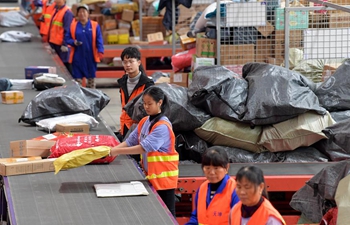
As the backbone and engine for promoting development and prosperity in the region, China and ASEAN hailed the continued strong growth in bilateral trade, investment and tourism flows.
The two sides have pledged to intensify efforts to meet the joint target of 1 trillion U.S. dollars in trade volume and 150 billion dollars in investment by 2020 through deepening economic linkages and improving connectivity with an eye on more fruitful results in trade and investment by 2030.
They remained committed to intensifying efforts to finalize negotiations for a modern, comprehensive, high-quality and mutually-beneficial Regional Comprehensive Economic Partnership agreement, boosting physical and institutional connectivity to bring markets closer together, deepening financial cooperation, enhancing dialogue and exchanges in maritime economic cooperation, engaging in the process of economic globalization and facilitating further economic integration, among others.
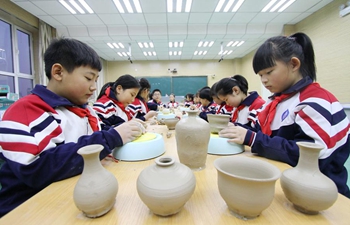
While encouraging people-to-people exchanges and cooperation between them for a better future, the two sides said they would promote youth exchanges in the fields of language learning, culture, art and heritage.
They would also strengthen cooperation in environmental protection, water resources management, sustainable development and climate change, and promote policy communication among governments.
ENHANCE CONNECTIVITY
The vision encouraged the two sides to enhance mutually-beneficial cooperation on the Master Plan on ASEAN Connectivity (MPAC) 2025 and the China-proposed Belt and Road Initiative (BRI).
Proposed in 2013, the BRI aims to build trade and infrastructure networks connecting Asia with Europe and Africa along the ancient Silk Road trade routes, while the MPAC 2025, adopted by ASEAN leaders in 2016, aims to optimize trade routes in the bloc to ease the movement of goods and increase business opportunities.
ASEAN has always been a priority in China's neighborhood diplomacy, and is also a priority region in the construction of the Belt and Road.
With the adoption of the 2030 vision, China and ASEAN will further enhance the synergy between the two plans, with connectivity projects such as the China-Laos Railway, China-Thailand Railway and Jakarta-Bandung Railway already under implementation.
The vision 2030 also reiterated the commitment of both sides to sub-regional and regional cooperation, and welcomed continued strengthening of cooperation under relevant sub-regional frameworks and cooperation mechanisms to support the efforts to narrow the development gap in the region.
Proposed by China in 2014 and grouping six countries along the Lancang-Mekong River, including Cambodia, China, Laos, Myanmar, Thailand and Vietnam, the Lancang-Mekong Cooperation (LMC) is one of the most prominent sub-regional frameworks. Most of the LMC's 45 early harvest projects and 13 initiatives have already been completed or recorded substantive progress.
CHART DIRECTION FOR TIES
The vision has been hailed as a milestone in the relations between the two sides, charting the future direction to advance their strategic partnership to new heights.
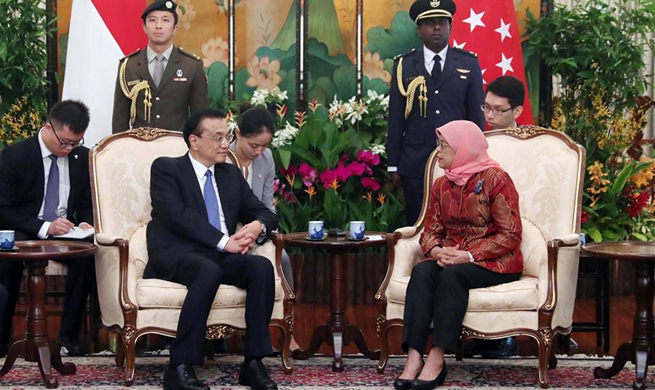
The vision "will chart the strategic direction of our cooperation," Singaporean Prime Minister Lee Hsien Loong said.
The vision will lay a solid foundation for the strategic partnership between the two sides in the coming decades, ASEAN Secretary General Lim Jock Hoi commented.
Phay Siphan, Cambodia's secretary of state and spokesman for the Council of Ministers, said that the vision is a concrete road map for both China and ASEAN to work together to build a community with a shared future.
"The vision reflects high commitment of both sides to building a region of ensuring peace and stability, common development and shared benefits for all," he said.
"It features stronger mutual trust and win-win cooperation between the two sides. Closer partnership between China and ASEAN should serve as a role model for countries all around the world," he added.
Joseph Matthews, director of the ASEAN Education Center, said the vision is a milestone in the relationship between the two sides. "The vision is based on the win-win policy where both partners will benefit from each other."
Thonglor Duangsavanh, editor-in-chief of Vientiane Times, a local daily, said closer people-to-people exchange that China and ASEAN have promised will contribute to and promote the mutual political and security trust as well as pragmatic economic and trade cooperation between the two sides. Enditem
(Xinhua reporters Zhang Jianhua in Vientiane, Yu Qianliang and Zheng Shibo in Jakarta, and Nguon Sovan in Phnom Penh contributed to this story.)