Xinhua Headlines: How China's poverty alleviation efforts inspire rural revitalization abroad

* Located deep in China's Wuling Mountains, Shibadong Village is widely known as the birthplace of "targeted poverty alleviation." This approach became a cornerstone of China's successful national campaign to eradicate poverty.
* Shibadong's "targeted poverty alleviation" experience began to inspire places far beyond its mountains. Via this strategy, China had lifted 98.99 million impoverished rural residents out of poverty by the end of 2020.
* As a training base authorized by China's Ministry of Commerce, Hunan International Business Vocational College has trained over 15,000 people from more than 120 developing countries, many of whom have visited Shibadong Village for on-site learning.
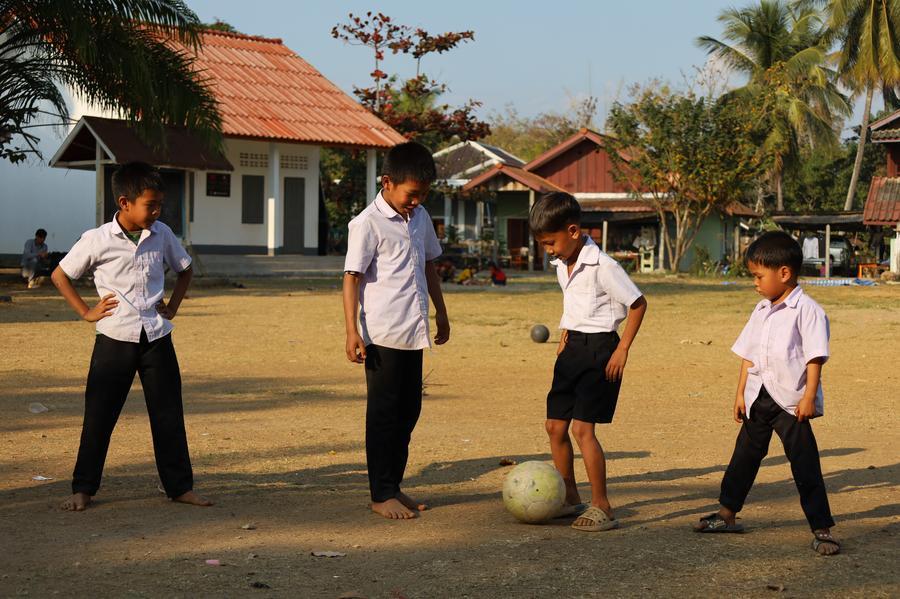
CHANGSHA, Feb. 26 (Xinhua) -- In Thinsom Village, nestled in the mountains of Laos's Luang Prabang Province, 54-year-old village chief Padith is eager to show a Chinese friend how his village has changed.
During a video call, he held up his phone proudly to introduce the village's first-ever kindergarten, built with help from a Chinese-invested company.
"Both the villagers of Shibadong and I are delighted to see how fast Thinsom Village has developed," said Shi Jintong, Party secretary of Shibadong Village in central China's Hunan Province, as he replied to the call.
Located deep in China's Wuling Mountains, Shibadong Village is widely known as the birthplace of "targeted poverty alleviation." This approach became a cornerstone of China's successful national campaign to eradicate poverty.
"Although Shibadong and Thinsom are more than 1,000 miles apart, we share the same goal: to push forward rural revitalization," Shi said.
Three years ago, the two villages signed an agreement of intent at the Shibadong Forum on Poverty Reduction and Development to become "international sister villages." Since then, inspired by Shibadong's example, Thinsom Village has started its own journey out of poverty.
POVERTY TO PROSPERITY
Shibadong Village's escape from poverty was neither fast nor easy. For decades, the village was isolated and endured much hardship. A narrow, often impassable muddy road was its only link to the outside world. Shabby homes offered little shelter from the cold, most households lacked running water, and per capita cultivated land was a mere 0.83 mu (about 553 square meters).
"In the past, after giving birth, women couldn't afford sugar or even an egg to restore their health," recalled villager Shi Shunlian. Back then, no vehicles could reach the village.
Yang Chaowen, 52, remembered how poverty forced many young and middle-aged villagers to leave for jobs in cities. Some, he said, had decided never to return to such a poor village.
The turning point came in November 2013, when the idea of "targeted poverty alleviation" was first put forward in Shibadong. This strategy tailored solutions to each household and individual, making support accurate and effective.
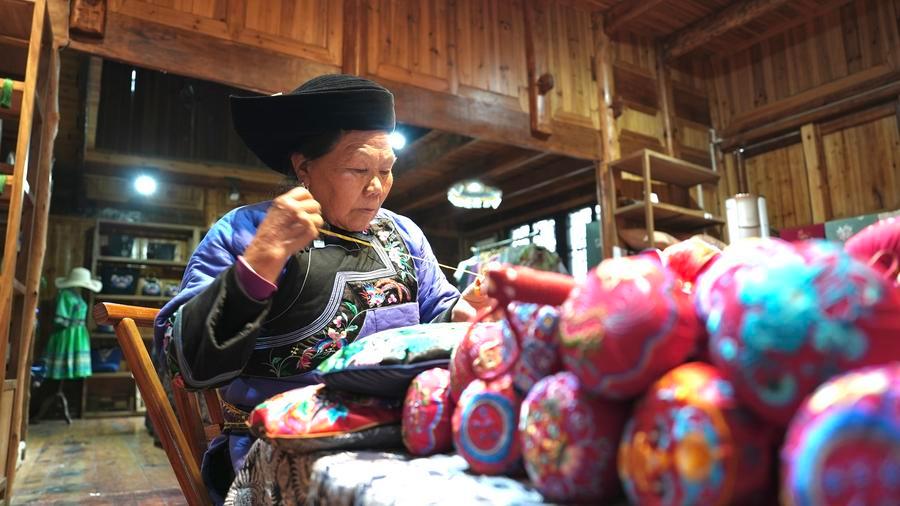
With help from village-based work teams, local infrastructure improved quickly. Roads were built and locally suited industries took root, including rural tourism, Miao embroidery and kiwifruit cultivation.
"Infrastructure, especially roads, is the precondition for poverty alleviation and rural revitalization," Shi Jintong noted.
Local people both joined in and benefited from the development. Wu Manjin, 47, once a housewife who seldom left home, now manages a Miao embroidery cooperative. The cooperative has helped 562 local women earn more money while staying close to home to care for their families.
Wu's husband, Long Xianlan, runs a local beekeeping factory that has created jobs and raised incomes. When asked about their 2026 goals, the couple said they hoped to improve their own lives and help other villagers achieve common prosperity.
Today, the old muddy road has been replaced by a smooth asphalt road. Every family has access to tap water and electricity. The village primary school and clinic have been upgraded, and the whole village enjoys wireless internet coverage.
As he enjoyed a free lunch at the village's day-care center, 80-year-old Long Yuanzhang told Xinhua: "Now that we are better off, we should help others do the same."
Like sunlight breaking through dawn, Shibadong's "targeted poverty alleviation" experience began to inspire places far beyond its mountains. Via this strategy, China had lifted 98.99 million impoverished rural residents out of poverty by the end of 2020, removing 832 counties and 128,000 villages from the national poverty list.
This milestone was not an endpoint but the beginning of a new development phase. The year 2025 marked the final year of the five-year transition period to consolidate and expand poverty alleviation achievements and integrate them with rural revitalization.
SHARING THE EXPERIENCE
The friendship between Shi Jintong and Padith shows how China's poverty alleviation experience is being shared abroad. Although their personal connection began in 2023, exchanges between the Chinese and Lao villages started earlier.
In 2018, Bounnhang Vorachith, then general secretary of the Lao People's Revolutionary Party Central Committee and president of Laos, visited Shibadong Village to learn about its poverty-reduction efforts. He later introduced the experience in Laos.
This marked the first time a foreign head of state had visited the mountain village. Since then, many foreign officials and international visitors have come to learn about Shibadong's changes and how similar methods might work elsewhere.
In June 2023, Abreham Yimer Abate, an official from Dire Dawa City, Ethiopia, visited Shibadong Village. He saw for himself how green development tailored to local conditions had reshaped the once-poor village. Deeply impressed, Abate noted that China's achievements show what can be done and encourage global efforts toward the same goal.
After returning home, he used Shibadong's experience to help poor communities in his country. "The key is changing people's thinking, so they no longer wait, depend on others or ask for help, but rely on themselves," he said. Programs in agroforestry, courtyard farming and environmental protection followed, improving both the environment and residents' incomes.
Local resident Habtam Temesgen has benefited from the courtyard farming initiative. "Having received baby chicks, feed and technical training, I now have a stable income from selling eggs and poultry. My life is getting better every day," he said.
That same year, Indian scholar Sudheendra Kulkarni visited Shibadong Village while attending the Shibadong Forum on Poverty Alleviation and Development. He said he was surprised by the village's transformation.
"It was hard to believe that a remote, hard-to-reach mountain village trapped in poverty could become a prosperous place in just 10 years," he said, adding that the experience was inspiring to his home country India. "This strategy is based on the principle of 'blood generation,' not 'blood transfusion,'" he told Xinhua.
These stories show how China's experience in poverty reduction and inclusive development has offered inspiration to countries charting their own development paths. As a training base authorized by China's Ministry of Commerce, Hunan International Business Vocational College has trained over 15,000 people from more than 120 developing countries, many of whom have visited Shibadong Village for on-site learning. To date, guests from over 100 countries have visited the village.

LOOKING TO THE FUTURE
For Shi Jintong, eliminating absolute poverty was just the first step. "Getting rid of poverty is not the final goal," he said. "We also need to help the villages around Shibadong become richer through regional coordinated development."
In September 2023, a rural revitalization plan was launched, covering Shibadong and nearby villages. It covers more than 45 square kilometers and benefits 8,961 people.
To fully showcase China's poverty reduction practices, the Shibadong Rural Revitalization College was established. "In 2024, we set up a foreign exchange point authorized by China Construction Bank at the front desk, because more and more international students are coming," Shi Jintong said, adding that some local villagers working as receptionists have learned basic foreign languages.
Xie Lijiao, whose husband is from Shibadong, came back to the village after years of working elsewhere. Now employed as a receptionist at the college, she earns 4,000 yuan (around 577.8 U.S. dollars) a month. "I can work close to home and take care of my child and family. It is much better than working far away," she said.
Since the college's establishment, Shi Jintong has become a part-time teacher. As someone who lived through the changes, he shares Shibadong's story with visiting trainees.
In 2025, Shibadong Village's per capita net income reached 30,755 yuan. Its collective income totaled 7.03 million yuan, and tourism revenue hit 14.95 million yuan. The college received 34,000 study visits.
Today, the village pulses with renewed vitality. "No matter what Shibadong was like before, its future is full of hope. I am so proud that Shibadong's story is being heard by the world," Shi Jintong said.
(Video reporters: Du Dapeng, Ma Huaizhao, Zhao Xu and Wang Yuping; video editors: Zhang Yucheng, Wei Yin and Zhang Ning)■









Comments